“[Balenciaga is] the only couturier. He is the only one who knows how to cut a fabric, and mount it and sew it with his own hands. The others are just draughtsmen.” — Gabrielle “Coco” Chanel
Grandpa Komm in his carport, with an arrangement of Grandma's favorite pink peonies from their garden, on what would have been their 69th wedding anniversary. (She died 8 months before this photo was taken and he died 6 months after.)
I like to think that I got sewing genes from both sides of my family. My mom used to sew her own clothes, her mom made beautiful tatted lace, and my dad’s dad was a tailor. Today marks the 101st anniversary of his birth, so I’m writing a tribute to him — my Grandpa Komm. He is one of my greatest inspirations and I am incredibly proud to carry his last name.
My grandfather, Wilhelm (William) Komm, was born in Schildesche, Westfalen, Germany in 1910. His father was a bricklayer who was drafted into the German army in 1916 and served on the Russian Front, leaving his wife and six children to survive the rest of the War on their own. They never had anything to eat; my Grandpa told my dad that they would share one egg between all of the children. In the sixteen years that he lived in Germany he had only experienced a full meal once, and it was long after the War; he was out begging for food in the countryside, and a compassionate farmer led him to the one empty seat at the table with his hired hands and said to him, “Sit down and eat, Son.”
Because he had been severely malnourished as a young child growing up during the War, by the time he was a teenager he was a slight, sickly kid and unfit for hard labor. At the age of 14, instead of becoming a bricklayer like his father, or a harness maker and upholsterer like his oldest brother, he was sent to be an apprentice in the local tailor’s shop because it was indoors and not physically demanding.
Two years later, in 1926, the family immigrated to Canada and settled in the small prairie town of Cardston, Alberta. They didn’t speak any English, but luckily the woman who ran the hotel where they stayed for the first few days spoke German and found out that my grandpa could tailor. The following morning she took him to the tailor’s shop on Main Street and he started sewing right away. For his day’s work he was paid one dollar. It was the first money that anyone in his family earned in Canada. I’m so proud that he was able to do that for his family. (And especially proud that he earned it by sewing!)
It’s impossible for me to imagine Grandpa Komm as a pale, sickly kid. I always knew him as the picture of health and vitality. He lived to be 3 weeks shy of his 96th birthday and kept himself busy doing all kinds of things, including mending and alterations for friends and neighbors, right up until the very end. Literally. Just a few hours before he suffered the stroke that caused him to pass away, someone had stopped by his house (yes, he was still living in his own home — with a driver’s license!) to drop off eight pairs of pants for him to alter… I can only hope that I’ll live to be 95 and still be making the dresses that I love so much to make!
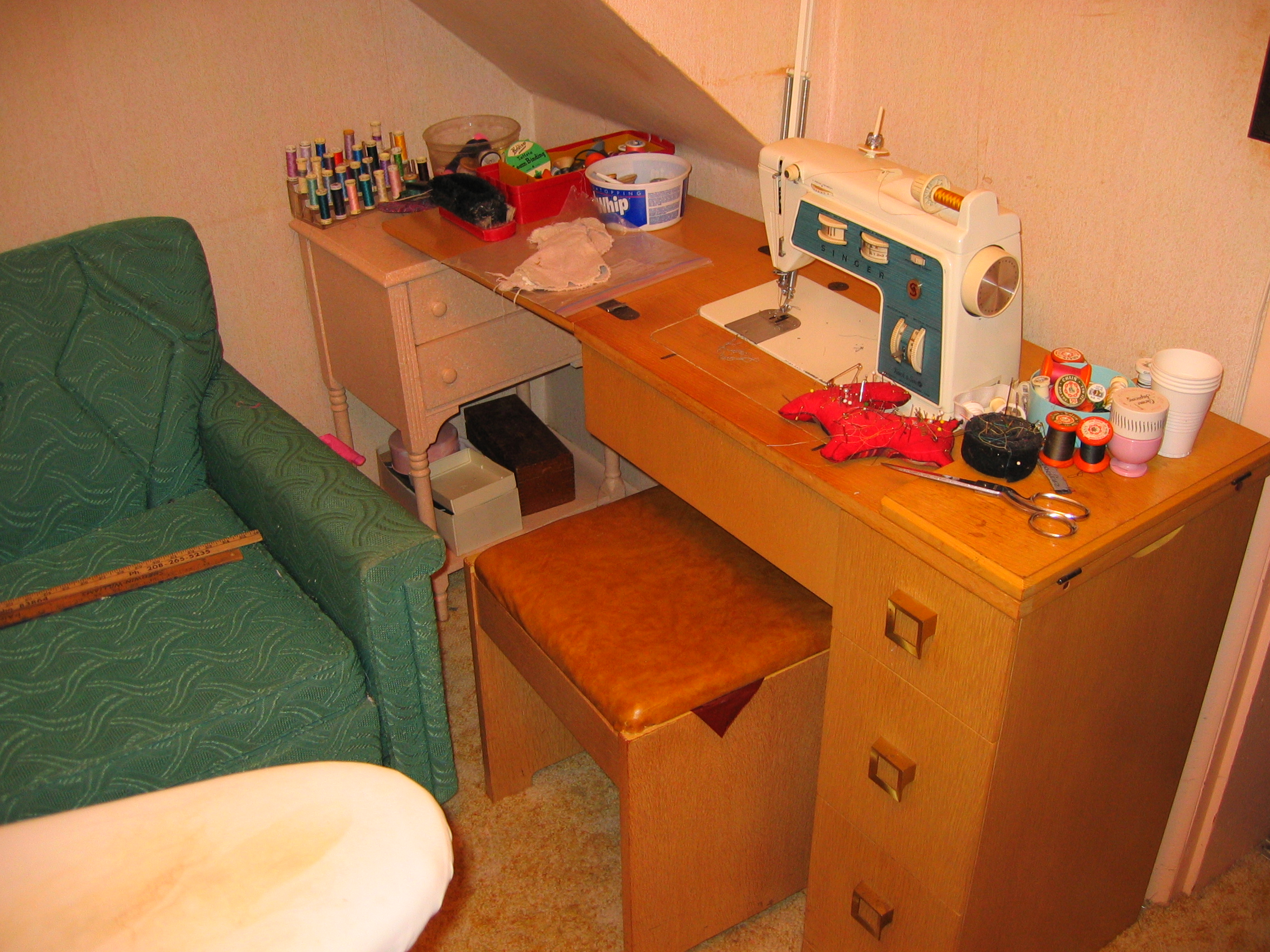
Grandpa Komm's sewing room in the tiny bedroom under the staircase, in the house he lived in for 64 years. (I took this photo about a year before he died, when I was there for my grandma's funeral.)
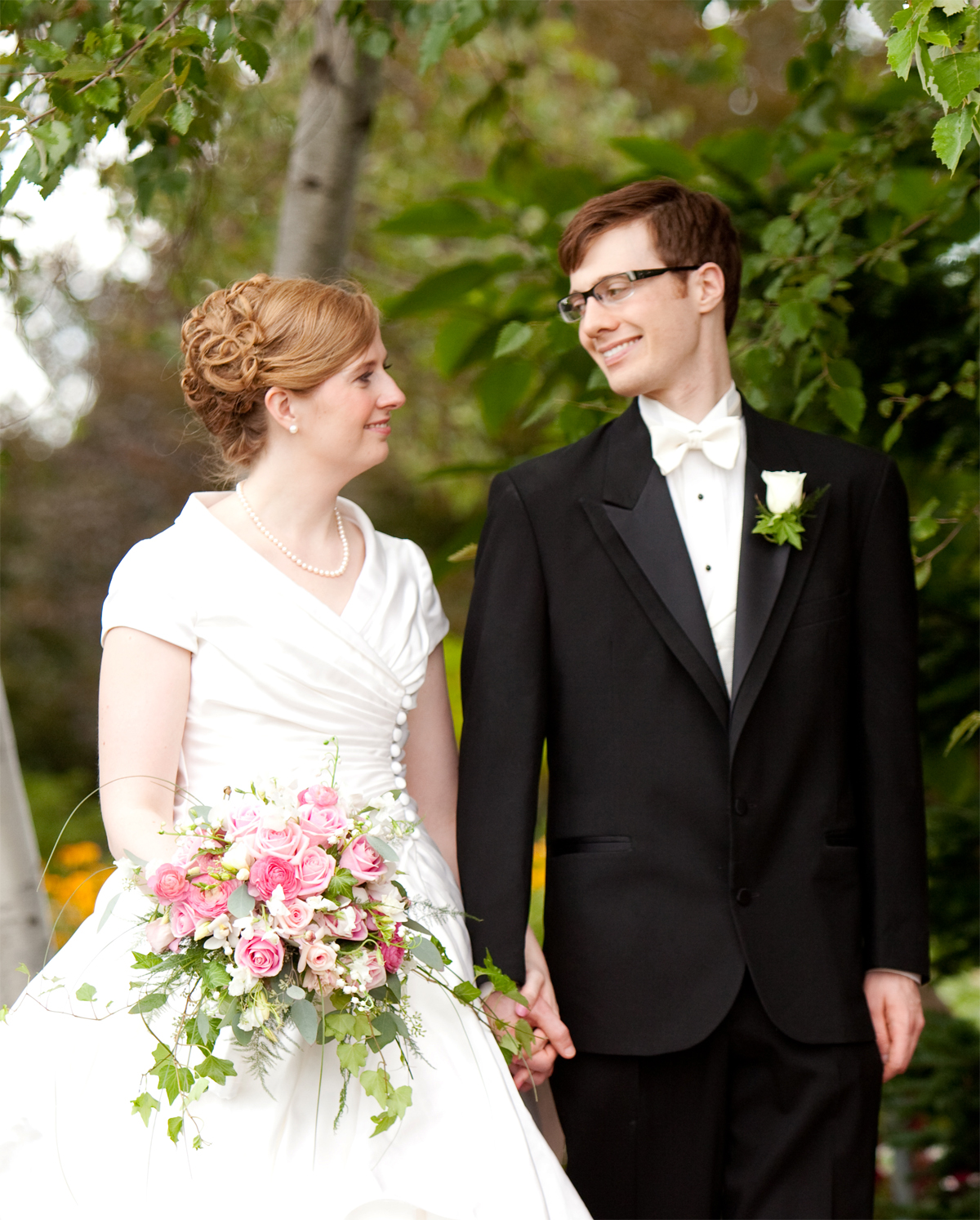
Something that I think is critically important in determining what a bride is going to look best in is to know what her groom looks like and what the two of them look like together. Weddings have become so bride-centric that the groom is often overlooked, but this day is just as much about him as you. It is about the two of you becoming one, and you should choose garments that visually reinforce that idea.
When I design a gown for a bride, finding out about her fiance is one of the first things I do. How can I make something for this bride that will not only look beautiful on her but also be complementary to her husband and make him look his best?
Remember that the most important pictures you will look back on from you wedding are the ones of you and your husband together and you don’t want your dress (or your hair or makeup, for that matter) to draw unnecessary attention to itself, or overpower your husband. (Think about all the wedding photos from the 1980’s — how many brides regret the lacy beaded pouffy shiny satin sleeves?!)
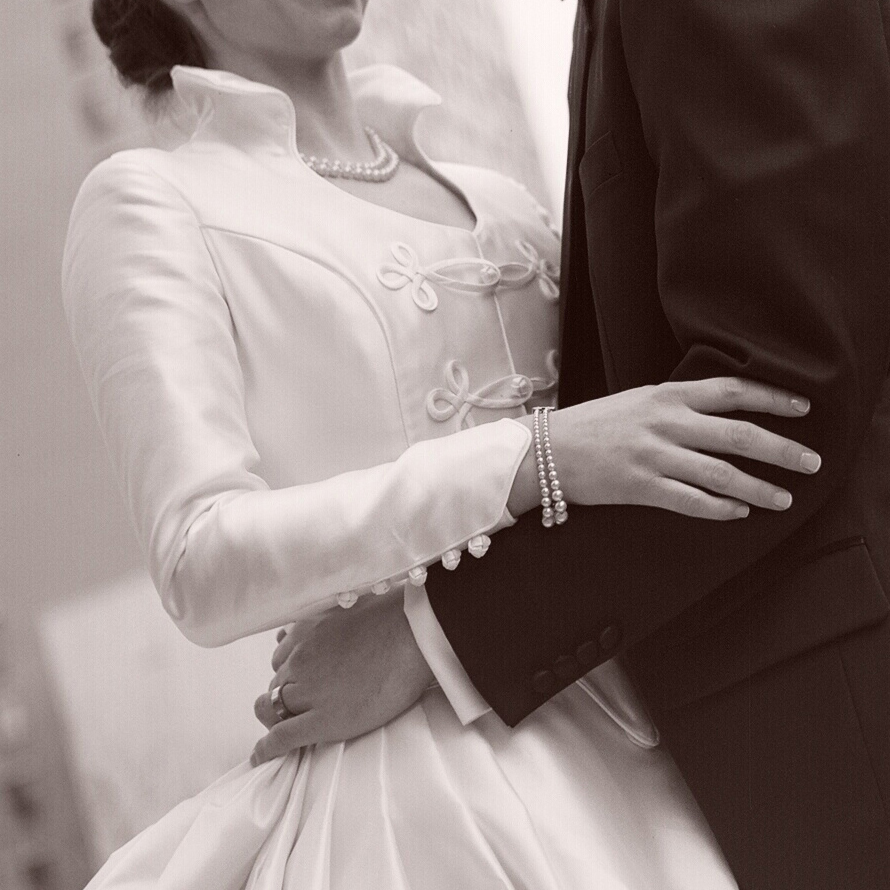
This bride wanted the Princess Dress, but was getting married in December in New York, so I made it with long sleeves. I think I like it even better this way, with the Chinese ball button closure at the sleeve vent.
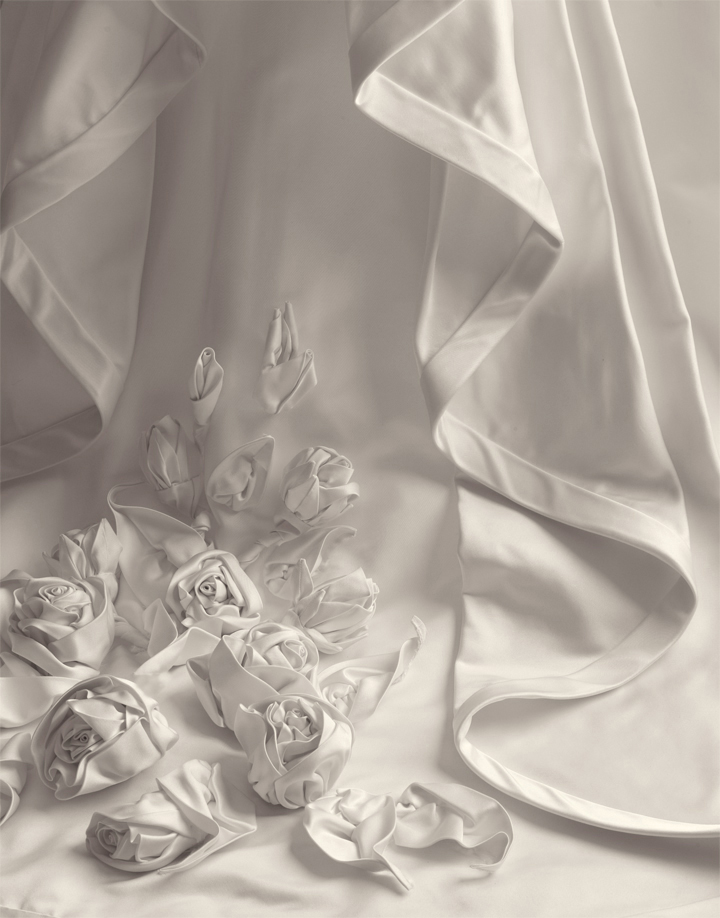
I’m obsessed with how the fabric looks in this photo. It’s a gorgeous Italian silk double-faced duchesse satin that I specifically chose for its luster, which perfectly accentuates all the gathering on the bodice.
A few weeks ago while I was getting my mail I noticed something really special: a hand-addressed envelope done in characteristic Bernard Maisner style. Was someone getting married? I turned it over to see the return address. It was from Bernard Maisner himself! It was an invitation to join him and his business partner Lisa McCarthy for a “dinner soiree” at her Upper East Side home. I was so excited to be invited, this was a pretty big deal!
Bernard and I met a year ago at the Wedding Library/Martha Stewart Weddings Event while I was wandering around looking at the different vendor displays. His work is so out-of-control amazing that I spent quite a while fixated on the samples he was displaying. I’m obsessed with anything handmade, intensely detailed and perfectly executed, especially if it bears the distinct style of its creator. Bernard’s work fits into all of those categories. We began talking about what each of us do and had a creative-person bonding moment over the fact that we are both kind of artistic luddites, completely obsessed with carrying on our respective old-world crafts (albeit with current sensibilities) in a modern age.
The dinner was night before last and it was a truly wonderful evening. A really great mix of friendly and fascinating people, wonderful conversation, delicious food. My favorite part, though, was when Bernard gave a little speech. He held up a business card — his first ever business card — that he had made as a teenager. No, it wasn’t an elaborately illuminated piece of script. It was a white, typed, return address sticker affixed to a piece of yellow cardstock. He told us that once he had affixed all one hundred of the labels he realized, “it only had my address on it, so I had to write in my name and phone number underneath!” We all giggled at the irony, as this little cobbled together business card bore no resemblance at all to the exquisite and sophisticated stationary that he now creates for his clients!
I love seeing where talented, creative, and successful people started from, and especially where they can get to by following their artistic vision and dedicating themselves to their craft. What an inspiration!
“In a machine age, dressmaking is one of the last refuges of the human, the personal, the inimitable. In an epoch as sombre as ours, luxury must be defended inch by inch.” — Christian Dior, 1957
As found in one of my favorite books, Couture and Commerce, by Alexandra Palmer.
“The classic way to design a dress is to work on it on a live mannequin. A sketch is only the ignition of your inspiration, but the dress takes its true shape when made on the human form. I learned this cardinal rule from Molyneux, who saved me from architecture and gave me my start in the fashion world. I also learned from him never to add anything to a dress during a fitting. Always simplify — that’s the rule.” — Pierre Balmain
From the May 1980 Playbill article, Balmain on Broadway, a segment of which was on display at On Stage in Fashion exhibit that I visited yesterday. I went back today with a pen and paper to copy down this quotation because I couldn’t stop thinking about how true a statement it is.





 Everything She Seams...